Financial Sector: Nominal stability and real risks
Anastasiya Luzgina
Summary
In 2025, Belarus’s financial sector persisted amidst ongoing geopolitical uncertainty and sanctions. The Belarusian ruble’s exchange rate remained closely linked to developments in the Russian currency market. Simultaneously, the National Bank of Belarus put in place measures to boost economic growth by encouraging banks to expand investment lending.
Analysis suggests that, despite nominal stability in the financial sector over the past year, there remain ongoing risks of potential deterioration in the future.
Trends
- International reserve assets hit a record high, primarily driven by situational factors;
- The financial regulator encouraged investment activity;
- The EU escalated its sanctions pressure on the banking sector;
- The Belarusian ruble remained stable throughout the year, with the foreign exchange market situation still dependent on fluctuations in the Russian ruble’s exchange rate.
Brief overview of banking sector performance and external debt
The National Bank reported that throughout 2025, the banking sector demonstrated consistent reliability and stability. Key indicators suggest an almost perfect financial health: the capital adequacy ratio reached 19.2 %, well above the regulatory minimum of 10 %. The total liquidity coverage ratio stood at 158.6 %, comfortably exceeding the minimum requirement of 100 %. Additionally, the proportion of non-performing assets within banks’ credit portfolios was only 2.2 %, significantly below the maximum permissible limit of 10 %.1
The National Bank’s policy of reducing dependence on foreign currencies (de-dollarization) contributed to a decline in retail deposits denominated in foreign currencies, while deposits in Belarusian rubles experienced robust growth. Over the past year, fixed-term ruble deposits increased by over 39.5 %, marking the highest growth rate in the last five years. Consequently, compared to early 2021, fixed-term retail deposits denominated in Belarusian rubles nearly tripled, reaching an equivalent of USD 15.2 billion.
In addition to deposit growth, there was a remarkable expansion in gold and foreign exchange reserves. As of January 1, 2026, these reserves totaled USD 14.4 billion, representing a 61.6% increase over the year (see Figure 1).2
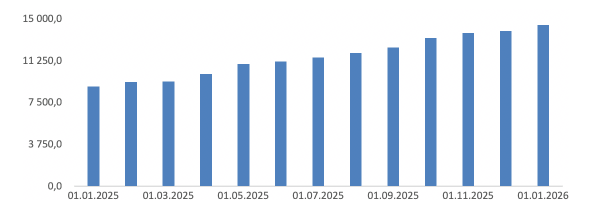
Figure 1. International reserve assets of the Republic of Belarus in 2025, USD million
Source: National Bank of the Republic of Belarus
Based on the latest data for the third quarter of 2025, Belarus’s gross external debt amounted to USD 37.15 billion, representing 42.9% of GDP.3 As of the end of the third quarter of 2025, the external debt of the public sector decreased by USD 105.6 million, totaling USD 17 billion.4 These indicators suggest a relatively low external debt burden for the country.
Financial sector risks
A more detailed analysis indicates that the situation in the financial sector was partially shaped by short-term factors.
In 2025, the National Bank actively encouraged investment lending,5 with ceiling interest rates for investment loans remaining lower than those for other types of loans.
According to the National Bank’s data, investment loans grew by 50% in 2025. On the one hand, the significant increase was expected to bolster GDP growth. On the other hand, more favorable financial conditions for enterprises to implement investment projects could carry significant risks. Given Belarus’s practice of mandating the fulfillment of government plans, there is a possibility that, over time, some of these investment projects may prove to be unprofitable. This could, in turn, lead to a rise in the proportion of non-performing loans.
The second notable aspect of the credit and deposit market in 2025 was linked to the substantial increase in fixed-term ruble deposits held by households, fueled by the active growth in personal incomes throughout 2024–2025. Amid labor shortages, enterprises and companies were compelled to increase wages despite a decline in operational efficiency. Notably, in 2025, the growth in real wages surpassed productivity growth by 8 percentage points. When adjusted for inflation, real wage growth reached 9%,6 although this was lower than the double-digit increases seen in 2024.
Looking ahead to 2026, a 40 % increase in irrevocable fixed-term retail bank deposits denominated in Belarusian rubles is anticipated. However, achieving this target will be challenging given the slowdown in wage growth.
With robust income growth, Belarusians had increased opportunities to save and invest. Given the limited development of the country’s stock market, bank deposits continued to be the primary method for building savings. However, foreign currency savings became less appealing due to the depreciation of the U.S. dollar against the Belarusian ruble throughout the year and the low yields on foreign currency deposits.
Meanwhile, households were withdrawing their fixed-term foreign currency deposits. As a result, in recent years, Belarusians have predominantly been net sellers of foreign currency. Non-resident companies also sold more foreign exchange than they purchased. In 2025, non-residents and the local population collectively sold USD 3.5 billion on a net basis. This not only satisfied the USD 2.3 billion7 demand from importers but also allowed the National Bank to buy foreign currency, contributing to the growth of foreign exchange reserves.
The main factor driving the growth of Belarus’s international reserves, however, was the rising price of gold. Over the course of the year, gold’s value increased by approximately 40 %, or more than USD 1,000 per troy ounce. Since foreign exchange reserves are traditionally valued in U. S. dollars, this increase largely reflects the appreciation of gold in U. S. dollar terms.
Furthermore, it is important to acknowledge that Belarus has not consistently managed its external debt properly. The country continues to default on its obligations to foreign Eurobond holders. For example, on December 29, 2025, the Ministry of Finance replaced the Eurobonds maturing on December 29, 2027 with domestic government bonds, marking a significant deviation from the original contractual commitments.8
On December 29, the Ministry of Finance officially executed an interest payment on its Eurobonds, totaling the equivalent of USD 12.2 million.9 Instead of settling the interest in the currency specified in the contract, though, the ministry transferred an equivalent amount in Belarusian rubles to a dedicated account at Belarusbank. This transaction enabled it to formally fulfill its current obligations to creditors, while international reserves remained intact.
Furthermore, in 2025, Belarus once again had its debt to Russia refinanced. Payments on the principal of state loans, originally scheduled to be paid in the second half of the year and amounting to approximately USD 250 million, were deferred to the period between 2027 and 2032.10 Similar refinancing arrangements had been utilized in previous years.
Outlook for gold and foreign exchange reserves: trends and stability
Although gold and foreign exchange reserves experienced significant growth over the past year, their medium-term outlook suggests potential decline due to several factors. First, the recent increase in reserves is mainly driven by rising prices of gold. Should the gold market reverse course and decline, Belarus’s international reserves could quickly diminish.
Second, considering the persistent trade deficit, which reached USD 1.8 billion in 2025 for commodities and services, there is a risk of increased demand for foreign currency as its supply tightens. In 2025, as in 2024, the population largely offset foreign currency demand from businesses. However, this balance may change over time. The population’s foreign currency deposits are finite. While at the beginning of 2020, Belarusian fixed-term foreign currency deposits stood at USD 6.2 billion, by the start of 2026, this figure had shrunk to USD 2.5 billion.
Foreign currency inflows continued through personal remittances from Belarusian citizens working abroad. In the first three quarters of 2025, these amounted to USD 880 million.11 However, the volume of such currency inflows may fluctuate over time, especially due to sanctions restrictions.
There was a slight decline in the supply of foreign currency on the domestic market amid a weakening U.S. dollar. In 2024, the population sold a net USD 1.69 billion, whereas in 2025, net sales edged down to USD 1.63 billion. If the U. S. dollar strengthens, the population is likely to sell less foreign currency. This could, in turn, increase pressure on the ruble’s exchange rate and compel the National Bank to begin selling foreign exchange reserves to curb the ruble’s depreciation and prevent panic.
Third, Belarus remains relatively unattractive to foreign investors due to ongoing sanctions and a negative international reputation, which poses risks to the future stability of its gold and foreign exchange reserves.
Foreign exchange market: dependence on the Russian ruble
The impact of domestic economic factors on the Belarusian ruble’s exchange rate movement can be regarded as neutral. Despite a nearly USD 7 billion trade deficit in commodities, the ruble appreciated against a basket of currencies over the past year.
This improvement was supported by growth in net exports of services — in 2025, services trade surplus totaled USD 4.2 billion.12 The situation also stabilized because the population and non-residents acted as net sellers of foreign currency. Consequently, between December 31, 2024 and December 31, 2025, the ruble strengthened against the basket of currencies by 0.91 %.
However, within the basket, mixed trends were observed. Over the year, the Belarusian ruble depreciated against the Russian ruble by 10.66 %. At the same time, it appreciated against the U. S. dollar by 16.43 % and against the Chinese yuan by 14.61 %.13
The decline in the U. S. dollar’s exchange rate against the Belarusian ruble was due to the weakening of the U. S. currency globally. For instance, the U. S. dollar weakened against the euro by approximately 15 %.14 Additionally, movements in the USD/BYN exchange rate were influenced by developments in the Russian currency market.
Over the past five years, Russia has evolved as Belarus’s primary trading partner and creditor. Furthermore, over 90 % of bilateral trade is conducted in their national currencies, predominantly in Russian rubles. As a result, the Belarusian ruble followed the trajectory of the Russian ruble’s exchange rate against the U.S. dollar, if not fully replicated it (see Figures 2 and 3).
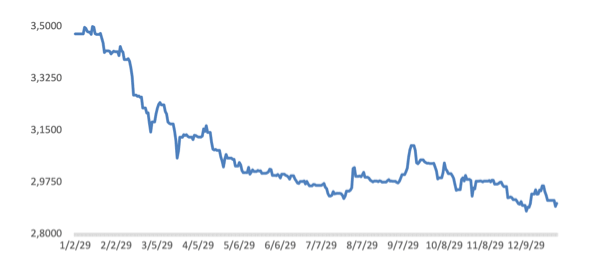
Figure 2. Exchange rate movement of the U. S. dollar against the Belarusian ruble in 2025, BYN per USD
Source: National Bank of the Republic of Belarus
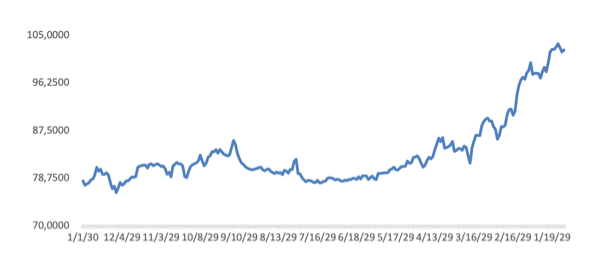
Figure 3. Exchange rate movement of the U. S. dollar against the Russian ruble in 2025, RUB per USD
Source: Central Bank of the Russian Federation
The dependence of the Belarusian ruble’s exchange rate movement on the Russian ruble could negatively affect the country’s exports if the national currency appreciates for reasons unrelated to domestic factors. Furthermore, this situation may lead to volatility in the currency market in case of sharp fluctuations in the exchange rates of the Russian and, consequently, Belarusian rubles. These risks are further amplified by the ongoing war in Ukraine and the continued enforcement of stringent sanctions on the Russian economy.
Escalation of sanctions against banks
Alongside Russia, Belarus as a co-aggressor is also subject to substantial sanctions. In 2025, sanctions on the banking sector were significantly expanded. For instance, the EU’s 16th sanctions package adopted at the end of February 2025, imposed restrictions on BelVEB Bank, BelGazPromBank, and VTB Bank’s subsidiary in Shanghai. Later, as part of the 19th sanctions package (October 23), banks such as Alfa Bank, Sberbank, and VTB Bank were also added to the list (see Table 1).
| Bank | Sanctions package, date |
|---|---|
| BelVEB Bank | 16th, February 25 |
| BelGazPromBank | 16th, February 25 |
| VTB Bank Shanghai | 16th, February 25 |
| Bank Dabrabyt | 18th, July 18 |
| BelInvestBank | 18th, July 18 |
| Development Bank | 18th, July 18 |
| BelAgroPromBank | 18th, July 18 |
| Alfa Bank (Belarus) | 19th, October 23 |
| Sber Bank (Belarus) | 19th, October 23 |
| VTB Bank (Belarus) | 19th, October 23 |
Table 1. List of banks subjected to EU sanctions in 2025
Source: EUR-Lex15
All dealings with the listed financial institutions are strictly prohibited. This includes not only the inability to perform international transfers or payments and the ban on establishing correspondent banking relationships, but also the blocking of any transactions made with payment cards issued by these sanctioned banks.
Similar restrictions, under the EU’s 18th sanctions package, were applied to four Belarusian banks previously disconnected from SWIFT. These are Bank Dabrabyt, BelInvestBank, Development Bank, and BelAgroPromBank (see Table 1).
The sanctions significantly restrict the operations of these banks.16 Essentially, clients of these sanctioned banks cannot perform transactions with counterparties in the European Union or process transactions through European banks. Notably, seven of these banks are classified as systemically significant.
The restrictions introduced by the 16th and 19th sanctions packages target Belarusian banks that engage with Russian payment services. In practice, however, most of these banks are integrated with Russia’s Faster Payments System (FPS) and the Financial Messaging System of the Bank of Russia (SPFS). Several Belarusian banks issue co-branded payment cards with the Russian MIR system and the Belarusian BELKART system. Consequently, there is a potential risk of these banks being included in the EU sanctions list in the future.
Furthermore, a ban has been imposed on all operations involving crypto-assets and electronic money for individuals and legal entities registered in Belarus. These measures aim to prevent sanctions evasion through digital payment channels.
The Belarusian authorities are actively exploring digital payment systems as a way to facilitate international transactions and bypass sanctions. Throughout 2025, the National Bank has repeatedly discussed developing a digital version of the Belarusian ruble, with plans for its launch in 2026.
The central banks of China and Russia are actively advancing the adoption of digital currencies. Moreover, in January 2026, Belarus signed a decree authorizing the operation of crypto-banks that will serve as hybrid institutions, combining the roles of traditional banks and cryptocurrency exchanges. One of the intended functions of these crypto-banks is to enable international settlements in cryptocurrencies, which could potentially make sanctions circumvention easier. In response, the European Union’s new restrictions on crypto-assets are designed to thwart such efforts.
Conclusion
In 2025, Belarus’s financial sector remained formally stable, mainly due to short-term factors and government intervention. The National Bank redoubled its efforts to stimulate economic growth through the banking sector. As a result, investment loans soared in 2025.
The increase in gold and foreign exchange reserves was driven by rising international gold prices and the population’s sale of foreign currency, motivated by unprofitable U.S. dollar savings. The exchange rate of the Belarusian ruble remained heavily influenced by developments in the Russian currency market.
Throughout the year, sanctions against banks were intensified. To mitigate the immediate and future adverse effects of these sanctions on the banking sector, the Belarusian authorities actively began developing the country’s cryptocurrency market.
In 2026, the National Bank will continue to support economic growth by shaping the financial sector. This will involve ongoing efforts to promote investment lending and extending programs for consumer loans to encourage the purchase of domestically produced goods. However, achieving a 40% increase in fixed-term irrevocable retail deposits denominated in Belarusian rubles may be challenging due to the slowdown in household income growth.
The Belarusian ruble’s exchange rate is expected to continue relying heavily on the Russian ruble. It is also likely that the U.S. dollar will strengthen against the Belarusian ruble, driven by similar trends in the Russian financial market and escalating tensions in the Middle East.
The level of gold and foreign exchange reserves will vary in line with gold prices, assuming there remains a sufficient supply of foreign currency on the domestic market. Current external debt payments are unlikely to significantly affect reserves, as some payments to the main creditor — Russia — may be deferred, and contractual payments on Eurobonds have been suspended by the Belarusian authorities.
The pressure of sanctions on Belarus’s banking sector will hinge on the prospects for ending the war in Ukraine. If the situation does not improve, the list of banks restricted from transacting with counterparts in the European Union could be expanded.