Science and Innovation: An “optimistic tragedy”
Andrey Laurukhin
Summary
In 2025, the most recent State Program for Innovative Development was concluded. It was accompanied by triumphant official reports amid a significant decline in citations in international databases and a drop in the Global Innovation Index ranking. Over the past five years, Belarus’s innovation system has failed to escape the trap of low innovation activity. Belarusian scientists and innovators have shifted their focus toward international cooperation with the Russian Federation, China, and the “far arc” countries.
Belarus’s financial, infrastructural, cognitive, and informational dependence on Russia has substantially increased. With ongoing repression and (self)isolation from developed democracies, sanctions pressure, and role in facilitating Russia’s military acts against Ukraine, Belarus has set new priorities in science and innovation: import substitution, strengthening of the military-technical sector, and robotics.
Trends
- Decline in the citation index of Belarusian scientists in high-ranking international databases, such as Scopus or Web of Science;
- Deterioration of the human resource capacity of Belarusian science;
- Greater dependence on the Russian Federation and the People’s Republic of China for innovation;
- Growth in the share of R&D and innovation for the defense industry.
Trap of low innovation activity
The State Program for Innovative Development for 2020–2025 concluded in 2025, and official statistics along with public reports from officials sound optimistic. In 2025, the five-year growth in R&D/GDP intensity continued: in 2021, it was 0.46 %; in 2022, 0.47 %; in 2023, 0.57 %; and in 2024, 0.59 % of GDP.
Compared to several post-Soviet countries (Kazakhstan with 0.14 % of GDP, Azerbaijan with 0.18 %, Armenia with 0.18 %, and Moldova with 0.22 %), Belarus looks quite strong.1 However, this growth remains significantly below the internationally recognized threshold of 1.0 % and falls short of the figures seen in neighboring Former Soviet Union (FSU) countries that are members of the European Union. For instance, in 2025, Lithuania’s R&D/GDP intensity showed steady growth, settling between 1.5 % and 2.0 %.
Another equally important indicator of scientific potential — the number of researchers per 10,000 population — increased by more than 10 % compared to 2021: in 2021, it was 17.5; in 2022, 17.8; in 2023, 18.7; and in 2024, 9.4 researchers.2 This figure is higher than in the above FSU countries, but remains significantly lower than in developed countries worldwide. Over the past decade, countries like Poland, Cyprus, Greece, Hungary, Portugal, Sweden, and Belgium have seen researcher numbers grow by over 60 %. On average, the EU has about 100–150 researchers per 10,000 population. Leaders such as Germany and Scandinavian countries significantly surpass this level, while Eastern European countries are somewhat below the average.
Overall, the main indicators of innovative development have traditionally increased within a range below the critical thresholds recognized in developed countries. In this perspective, Belarus appears relatively decent only when compared to countries with even less advanced innovation systems. However, when measured against more developed nations, it lags considerably behind. The growth of innovation metrics, which stays below the necessary threshold — insufficient to achieve a breakthrough or move to a higher category — is described by international experts as low innovation activity or insufficient innovation output. This leads to a more realistic conclusion: Belarus remains stuck in a trap of low innovation activity.
This is the reason why Belarus ranks very low in the 2025 Global Innovation Index (85th out of 139 countries), and the five-year trend (spanning 2020 through 2025) is largely negative, with a decline of eleven positions in the global ranking.3 A more detailed analysis shows uneven changes in indicators in the short term and a prevailing negative trend over the longer term.
If we take “science and innovation investment,” the situation with scientific publications improved in the short term (+51% between 2023 and 2024), but worsened over the past decade (minus 0.7 %). R&D investments expanded by 26.6 % in 2022–2023, but decreased by 0.9 % compared to 2013. The number of venture capital deals dropped by 66.7 % in 2022–2023. International patent fillings shrank by 18.8 % between 2023 and 2024, but remained unchanged in the period between 2014 and 2023.
Patent activity is notably a key comprehensive indicator — both quantitative and qualitative — of the effectiveness of R&D and the innovation activity of organizations, regions, and countries. It reflects the capacity to generate new scientific and technical solutions, demand for them, and their commercial viability. For Belarus, this indicator speaks for itself: since 2015, the number of patent fillings has decreased by more than 55 %, with applications from foreign applicants falling by over 65%; the number of granted patents has dropped by almost 70 %, and patents granted to domestic applicants, by more than 70 %; the total number of active patents has halved.4
When it comes to “technology adoption,” the situation with safe sanitation was at “zero” between 2023 and 2024, and minus 0.2 % in the previous period beginning in 2014. Connectivity improved both in the short (+2.4 % in 2022–2023) and in the long term (+1.4 % since 2013). However, there are no data on the deployment of 5G in Belarus, as it is just beginning to be rolled out now. The development of robots declined in the short term (minus 17.5 % in 2022–2023), but showed a slight improvement of 3.3 % since 2013.
In terms of “socioeconomic impact,” labor productivity increased both in the short term (+4.4 % for 2023–2024) and over the long period (+1.2 % since 2014). Life expectancy grew by 0.1 % in 2022–2023 and by 0.2 % since 2013.
Overall, Belarus is among the countries with the highest levels of human capital development and research (rank 39), performs fairly well in knowledge and technology outputs (49), but ranks below average in infrastructure (85). The country ranks lowest in institutions (137), market sophistication (102), and creative outputs (94).5
In the annual Human Development Index 2025, compiled by UN experts based on three primary and three additional indicators,6 Belarus was ranked 65th out of 193 countries.7
Decline in international citation index of Belarusian scientists despite RSCI leadership
The number of citations of Belarusian scientists in the Russian Science Citation Index (RSCI) surged significantly after 2022, and by 2025, it had become the primary and almost sole measure used. For example, the country’s leading Belarusian State University (BSU), in its official report on scientific, technical, and innovative achievements, primarily highlights its leadership in the volume of publications cited in the RSCI. It then modestly and somewhat evasively mentions the “position of BSU journals in the SCImago Journal & Country Rank, based on Scopus data”.8
Meanwhile, in the SCImago Institutions Rankings, which measures productivity of academic and research institutions based on research, innovation, and societal impact (measured by its visibility on the web), Belarus is represented by nine institutions with ranks ranging between 5,003 and 8,678. The highest-ranked is Belarusian State University with a worldwide rank of 5003.
The National Academy of Sciences (NAS) has a lower rank of 6,742, placing it well below the global median.9 Of the 27 NAS organizations, only two are ranked: the Scientific and Practical Center for Materials Science and the B.I. Stepanov Institute of Physics. This is because only these institutions meet two essential criteria: (1) publication of at least 100 Scopus-indexed works annually, and (2) ensuring that at least 75% of publications meet citation criteria. Additionally, the number of Scopus-indexed NAS journals is obviously insufficient.
The NAS has declined in rankings for ten years (since 2016), but the trend has markedly accelerated since 2021: in under four years, it dropped more than 1,700 positions (see Figure 1).
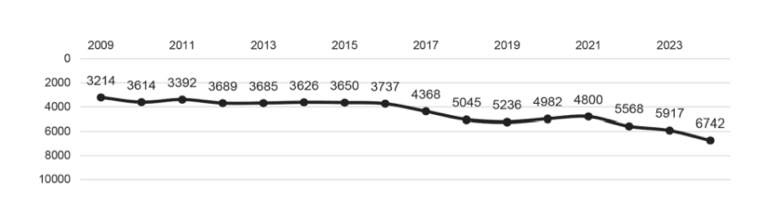
Figure 1. Overall ranking of the NAS of Belarus in SCImago Institutions Rankings, 2009–2024
Belarusian scientists are increasingly restricted in their access to reference databases such as Scopus and Web of Science due to sanctions. Experts from the Institute of Economics note that “as a result, many journals have stopped accepting articles from Belarusian authors. Cooperation with countries of the European Union, Canada, and the U. S. has stagnated, as these nations have adopted policies that deny our scientists involvement in current R&D and access to state-of-the-art technology. The number of Belarusian journals included in Scopus and Web of Science remains low.”10
Science and innovation within the research-oriented education sector: decline in human resources
The human resource capacity of research-oriented education has significantly deteriorated, based on official statistics. For instance, between the academic years 2020/2021 and 2024/2025, the number of permanent (full-time) academic staff decreased by 2,523 specialists. This included researchers with a candidate of sciences degree (minus 1,204), associate professors (minus 938), as well as doctors of sciences (minus 186) and professors (minus 144).
The key indicators of the Belarusian postgraduate school also show a negative trend over the same period: the number of educational institutions and organizations providing postgraduate programs (including postgraduate military courses) went down by 4; student enrollment fell by 703; admissions to postgraduate programs decreased by 44; and graduates from these programs dropped by 91 (including by 17 with defended theses). The reduction in the number of postgraduate students was relatively uniform across most scientific fields, except for six disciplines where an increase was reported: agriculture (+1), philosophy (+11), teaching (+40), arts (+58), sociology (+6), and political science (+40).
A similar pattern is observed in doctoral studies: despite a slight rise in the number of institutions and organizations offering doctoral programs (+2) and a more noticeable increase in doctoral graduates (+64, including 3 with defended theses), the number of enrolled students shrank by 111, and admissions to doctoral studies decreased by 64.11
New geography of international cooperation: unquestioned dominance of Russia and China
The sanctions and (self)isolation of Belarus from developed European nations have substantially reshaped the policies and geographic reach of the country’s international collaboration in science, technology, and innovation. To make up for the loss of Western European partnerships, the authorities are focusing on strengthening ties within the Union State, EAEU, CIS, and with countries of the “far arc” — including India, Pakistan, Turkey, Venezuela, Vietnam, Mongolia, Algeria, and others — with China playing a particularly prominent role.
Official figures show that in 2025, the leading foreign investors in the Belarusian economy were Russia (with approximately 30.0 % of the total), Cyprus (16.0 %), the UAE (11.8 %), China (10.1 %), and Qatar (4.1 %). In this context, Western European countries’ share appears modest: Germany with 2.6 %, the Netherlands and the UK with 2.1 % each, and the U. S. with 1.6 %.12 Notably, Russia and China account for most of the investments in Belarus’s innovation sector.
Cooperation with Russia in science and innovation remains dominant and virtually the only feasible option in terms of scale and investment. In 2025, thirty-two concepts were being drafted for new programs, including research in microelectronics, artificial intelligence, and new materials. Priority was given to innovations in the defense sector: in March 2025, the Parliamentary Assembly of the Union State of Belarus and Russia highlighted the need to accelerate the adoption of innovations to bolster defense capabilities and economic security.
Within this framework, particular attention is drawn to the joint development of a Russian-Belarusian ultra-high-resolution (UHR) Earth remote sensing vehicle (0.35 meters). Belarusian company ‘Peleng’ is responsible for designing and manufacturing the imaging equipment (telescope), while its Russian partners handle platform development and orbital deployment. The satellite project involves the National Academy of Sciences of Belarus, ‘Roscosmos’, JSC ‘Peleng’, and VNIIEM Corporation. The satellite has a dual purpose — civilian applications such as cartography, disaster monitoring, agriculture, environment, and urban planning; as well as military uses, including target recognition, monitoring of military bases, real-time reconnaissance, and precision weapon guidance. The satellite is projected to be launched in 2028.
Simultaneously, collaborative work continues in the fields of robotics, unmanned aerial vehicles (UAVs), and precision agriculture. At the beginning of 2025, joint engineering initiatives were launched to train skilled personnel for these sectors and other innovative dual-use industries. In August, a cooperation agreement was signed to address intellectual property matters, regulating the utilization of IT solutions and artificial intelligence.
Belarus – China collaboration ranks as the second most significant in terms of importance, scale, and investment. In September 2025, at the 18th Pujiang Innovation Forum, the results of the previously announced two-year (2024–2025) partnership in science, technology, and innovation were summarized. Almost 90 events took place, resulting in the establishment of 34 high-level joint platforms for scientific and technological collaboration, engaging 140 organizations from both nations. The main focus areas of this cooperation include artificial intelligence, space exploration, biotechnology, and healthcare.
The Chinese ambassador to Belarus stated that over a two-year period, the two countries conducted more than 60 scientific, technical, and academic exchanges, involving over 2,000 experts in areas such as artificial intelligence, information technology, biopharmaceuticals, laser technology, new materials, and agriculture. The Xi’an branch of the National Academy of Sciences of Belarus was inaugurated in China. Furthermore, the Guangdong Academy of Sciences and the National Academy of Sciences of Belarus established a joint industrial technology innovation center, which led to the development of a Belarusian atomic force microscope now available on the Chinese market.
The two parties collaboratively executed 47 scientific and technical projects, with a combined funding of CNY 80 million.13 According to First Deputy Prime Minister of Belarus Nikolai Snopkov, in 2025, over 60 investment projects involving Chinese capital and technology were implemented in Belarus, with declared investments amounting to approximately USD 1.6 billion. Most of these — 52 investment projects — were located in the Great Stone China – Belarus Industrial Park.14
New old leaders in science and innovation
In 2025, the country’s key science and innovation institutions had new leaders appointed: on May 22, Alexander Lukashenko appointed Vladimir Karanik as Chair of the Presidium of the National Academy of Sciences, and on November 20, Denis Korzhitsky was appointed Chair of the State Committee for Science and Technology. Both are purely administrative figures, with no scientific authority, professional reputation, notable achievements, or trust from the scientific community. They also have limited experience in managing scientific and innovative projects. These appointments symbolically emphasize the status of science and innovation institutions in contemporary Belarus as routine bureaucratic structures that can be managed by any official, regardless of their professional expertise.
Instead of a conclusion: directive innovations
On December 21, 2025, a new State Program for Innovation Development for 2026–2030 (SPID 2026–2030) was approved. It is planned to allocate around BYN 7 billion for the implementation of innovative projects and the promotion of innovation infrastructure under this program. Furthermore, there is an intention to “gradually reshape government support for innovative projects by shifting to a repayable preferential financing system” — meaning funds would be reimbursed over seven years (with an optional two-year extension) at an interest rate of 0.5%. Such conditions might discourage high-risk innovative projects rather than encourage them — particularly among SMEs.
At the same time, the emphasis in SPID 2026–2030 recognizes that innovative projects often stem from private “bottom-up” initiatives. Consequently, there are plans to broaden participation in the innovation process by introducing a new category of local projects, “representing innovations by small organizations and medium-sized businesses.” However, government oversight of this initiative is also being reinforced through new financial and administrative mechanisms. For instance, only organizations with more than 50% state ownership will qualify to act as beneficiaries of government-supported innovative projects.
At the same time, the innovation system will become even more bureaucratic and harder to manage, as two levels of decision-making are introduced: the Council of Ministers for national and comprehensive projects, and the State Committee for Science and Technology for local projects. The “simplification” of decision-making procedures proclaimed in SPID 2026–2030 effectively entails a tightening of government regulation and oversight — through the selection process of innovative projects deemed “of priority importance for Belarus’s development,” compilation of their lists and classifications, introduction of new regulatory legal acts, and other measures.
The program aims to achieve ambitious targets: by 2030, the share of innovation-active organizations in the manufacturing sector should reach 45 %, while the proportion of science-intensive and high-tech products in Belarusian exports should grow to 39 %.
The share of innovative products (works, services) new to the domestic or global markets shipped by manufacturing organizations is expected to reach 57.2 %, and the percentage of residents of technoparks investing in innovation should increase to 83.0 %.
It remains to be seen how feasible this is amid sanctions, Belarus’s self-isolation, and increasing dependence on Russia and China. A far more critical question concerns the quality, impact, and scale of innovations. Under the current status quo, it is unlikely that innovations will become a genuine driver of economic growth, social development, or improved living standards in Belarus over the coming years. Instead, innovations are more likely to retain a limited technical and technological character — focusing on dual-use technologies — and be used to reinforce primitive and archaic social structures, with the goal of establishing a more sophisticated yet rigid model of political control, governance, and citizen mobilization.