Media: Integration into the Russian propaganda ecosystem, semantic capture, fragmentation of the independent segment
Mikhail Doroshevich
Summary
In 2025, Belarus’s media landscape was shaped by three interconnected processes: accelerated integration of state media into the Russian propaganda ecosystem, ongoing fragmentation of the independent segment driven by emigration and repression, and the rise of short-form video content as a new arena for media influence. Drawing on a database of over one million documents from both government and independent sources, this analysis examines: the degree of synchronization between Belarusian state media and the Russian agenda, the lexical war surrounding Ukraine, the portrayal of the EU in the state media, and the advent of TikTok as a platform for political influence.
Trends
- Total — over 90 % — synchronization of the Belarusian and Russian state media agendas;
- Controlled narrative toolkit: strategic overhaul of the propaganda register; configuration of the repertoire to respond to geopolitical stimuli common to both Belarus and Russia;
- Lexical warfare as a methodological challenge: a sharp rise in the use of the term “special military operation” in independent media as forced citation;
- Escalation: TikTok as a new front in media influence.
Media landscape: structural divide
Throughout 2025, the Belarusian media landscape remained fundamentally split — a trend that had originated after 2020. The state-controlled segment, including BelTA, STV, ONT, Belarus 1, Belarus Today, and hundreds of regional media outlets with their Telegram channels, YouTube, and TikTok, operates as a unified media system with centralized narrative coordination.
The independent segment, comprising Zerkalo, Nasha Niva, Reform, Euroradio, and others, primarily operates from Lithuania, Poland, Germany, and Ukraine, with limited access to the domestic audience.
YouTube remains the main video channel for state media, whereas for independent content its significance as a platform has markedly declined. Continuous YouTube traffic monitoring (23,500 data points over 2,011 days between 2020 and 2025)1 identified the emergence of a “new normal” beginning in 2023: a stabilization of the average daily index at 22–25, down from the historical level of over 35. The peak was recorded on January 4, 2023, at 10:00 PM (83.22), while the all-time low coincided with the mass internet shutdown following the August 2020 elections (0.048). Three waves of outbound migration (2021 — content creators, 2022 — IT specialists, 2023 and beyond — ongoing) have structurally weakened the independent YouTube segment.
According to a Chatham House survey, 37.0 % of respondents watch Belarusian state TV channels daily or almost daily, 34.2 % watch Russian TV channels, 18.9 % follow Belarusian independent media, and 16.8 % consume Russian media in exile (see Figure 1). The authors argue that fear factor may result in up to 9 % undercount of critical responses.2
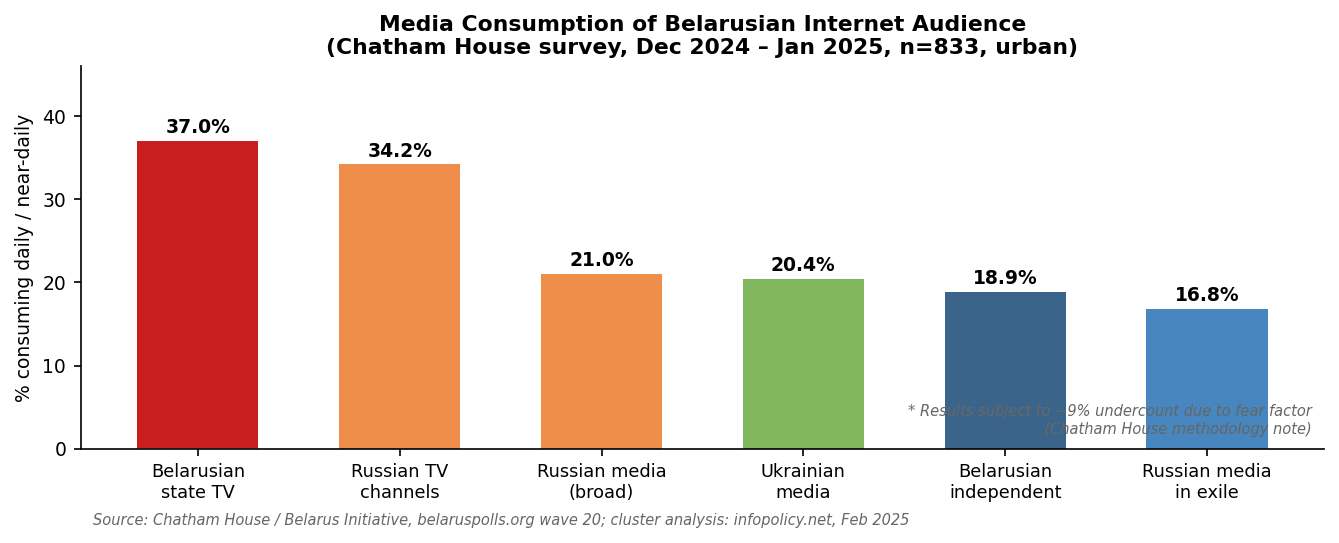
Figure 1. Media consumption of Belarusian internet audience (daily / near-daily)
Source: Chatham House / belaruspolls.org, wave 20; cluster analysis: infopolicy.net, Feb. 2025.
Independent media organizations faced a sharp financial crisis: on January 20, 2025, the Donald Trump administration froze foreign aid projects. According to Reporters Without Borders (RSF), six of the thirty largest Belarusian media outlets in exile lost all their funding; the frozen U.S. assistance accounted for over half of the total Western funding for the sector — around USD 30 million.3 The European Federation of Journalists (EFJ) called on European donors to compensate for the lost funds.
This financial crisis was further exacerbated by repressive measures. A report by the Belarusian Association of Journalists (BAJ) and Justice for Journalists recorded 478 cases of assaults and threats against media workers in 2025; as of February 2026, 28 journalists remained behind bars.4 The practice of remote criminal prosecution of journalists in exile — about 100 cases known by 2025 — has effectively turned emigration into a constant state of legal vulnerability.
Russian influence: five dimensions of integration
The concept of “Russian influence” is measured through five parameters: (1) citation of Russian experts, (2) citation of officials, (3) references to Russian media, (4) thematization of Russian television, (5) mention of Union State narratives. Methodological note: comprehensive monitoring of sb.by was initiated in 2025, ensuring comparability of the text corpus for that year, but limiting accurate comparisons with 2024.
Union State narratives
In 2025, the text corpus recorded 38,937 publications featuring Union State narratives, of which 93.7 % (36,497 items) came from state sources. The presence of independent media remains consistently low — 100 to 200 publications monthly — indicating that the category’s behavior is entirely driven by the editorial policies of state media, not an organic agenda. The peak month was August 2025, with 6,412 publications from state sources — directly linked to the deployment of Russian troops to Belarusian training grounds in preparation for the Zapad-2025 exercises (September 12–16). This was followed by September (4,763) and April 2025 (4,268 publications).
Citation of Russian experts and references to Russian media
In 2025, a total of 24,444 publications quoted Russian experts (89.9% from government sources), while independent media persist in keeping their distance, accounting for 2,480 publications. The category “references to Russian media” with 24,849 publications, of them 95.2% in the state segment, reflects direct content borrowing, including word-for-word reprints from TASS, RIA Novosti, and Russia Today.
| Synchronization indicator | Publications |
|---|---|
| Simultaneous topics with Russian media (same day) | 115 |
| Direct reprints of Russian sources | 426 |
| Publications on joint military exercises | 18,734 |
| Narratives about integration (civil) | 4,350 |
Table 1. Synchronization of Belarusian state media with Russian sources, 2025
Source: FORESIGHT/FactCheck. LT monitoring tool, Digitalhub VSI.
Data on synchronization confirm the institutional nature of integration: 115 instances of simultaneous same-day publication on the same topic with Russian state media, 426 instances of direct reprints, 18,734 publications about joint military exercises, and 4,350 narratives related to integration in the civic sector (see Table 1).
Russian narrative points
The most prominent narrative is “NATO as an aggressor” with 25,829 publications, of them 64 % in the state segment — the only category where the proportion of state media is notably below the average, indicating widespread dissemination of this idea across the media landscape.
In 2025, the “denazification” narrative (2,312 publications, 97 % from the state segment) was actively employed in the context of negotiations: state media used it seeking to legitimize Russian terms (see Figure 2).
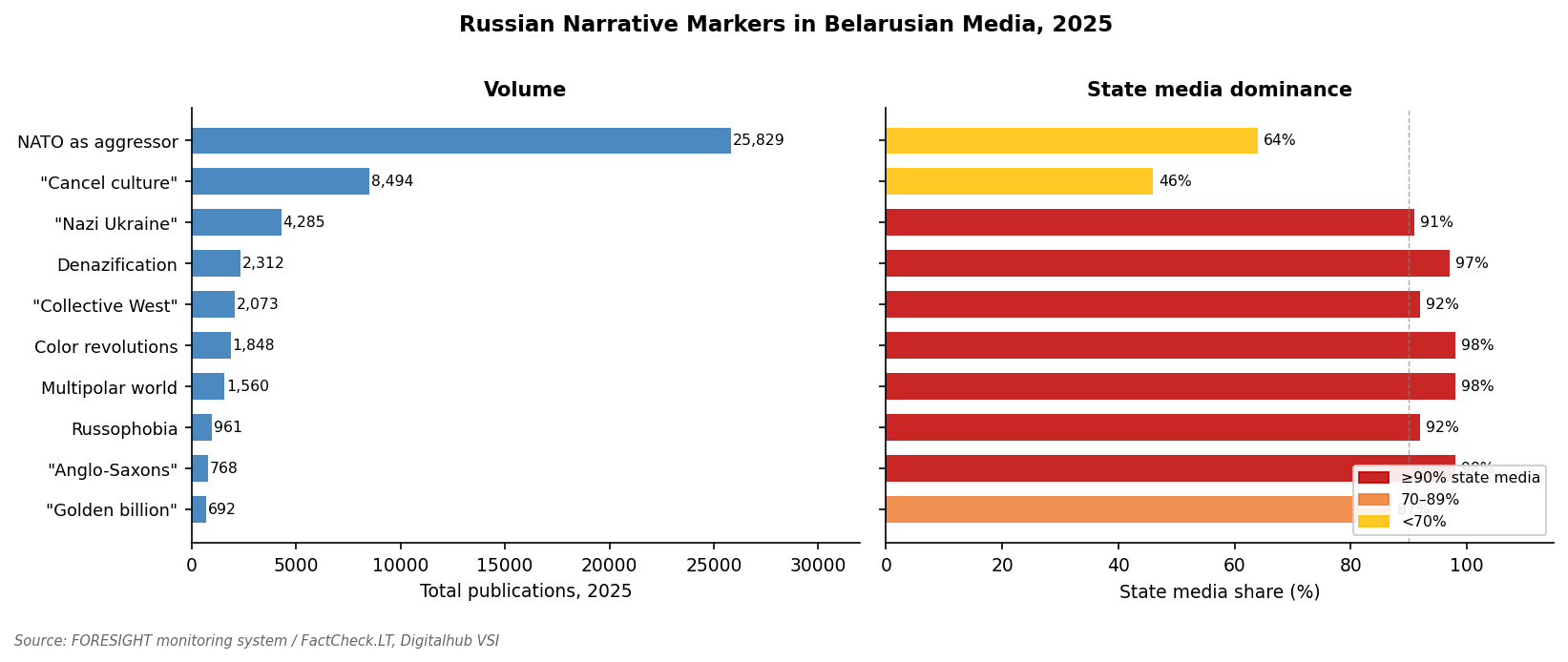
Figure 2. Russian narrative markers in Belarusian media, 2025 (left: total publications; right: state media share)
Source: FORESIGHT monitoring system / FactCheck.LT, Digitalhub VSI.
The “cancel culture” narrative (8,494 publications) is the only category where independent sources constitute a significant share (54 %). While state media used it to accuse the West, independent outlets employed it as a subject of critical analysis (see Figure 2).
Ukraine: four mirrors of a single war
An analysis of 488,635 publications on the Ukraine war, from both government sources (BelTA, Belarus Today) and independent media (Zerkalo, Nasha Niva, Reform, Euroradio), over four years, suggests the concept of “four mirrors”: each type of source reflects the war through its own set of filters.
Mirror One (government media): The war is depicted as a “conflict” instigated by Western aggression (see Figure 3). Key markers include: “special military operation” (2,013 mentions in the first quarter, state segment), “conflict” as a neutral substitute (6,638–7,494 mentions per quarter), and a notable absence of the word “invasion” (66–119 mentions versus 427–562 in independent media).
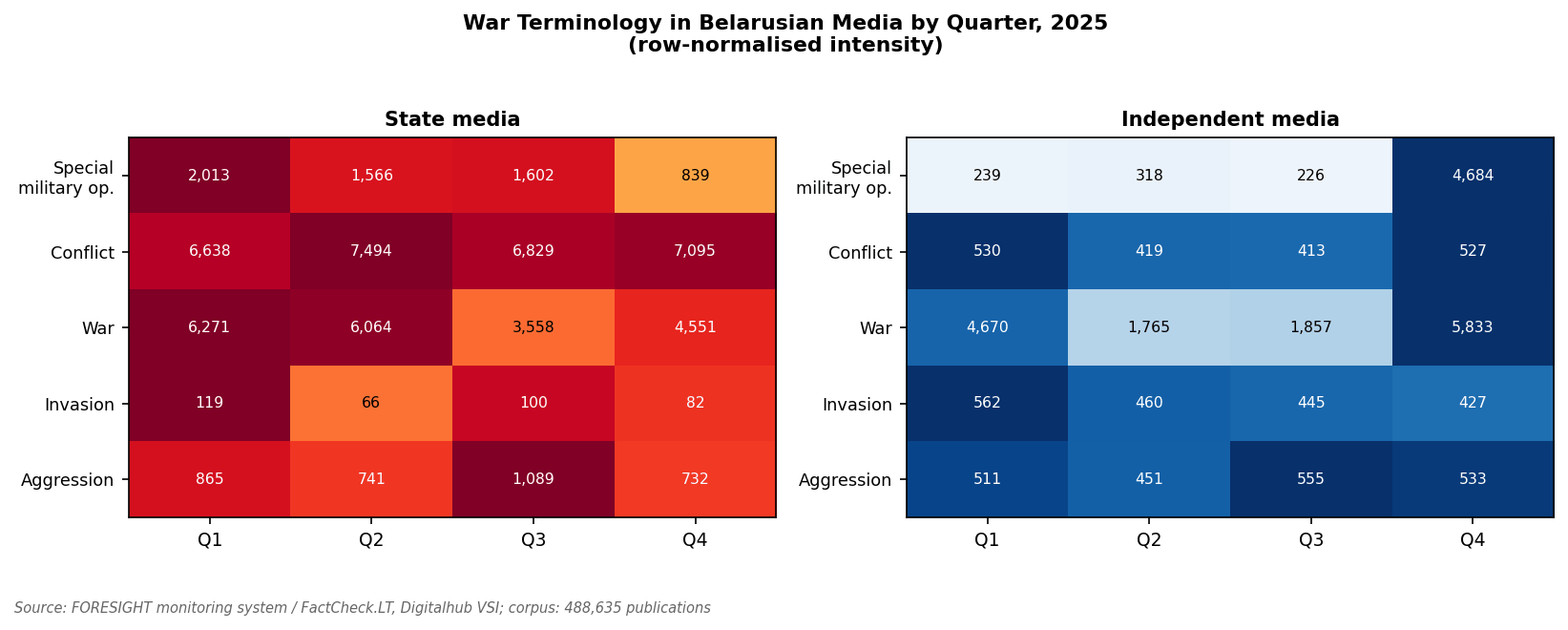
Figure 3. War terminology in Belarusian media by quarter, 2025 (row-normalized intensity)
Source: FORESIGHT / FactCheck.LT; corpus: 488,635 publications.
Mirror Two (independent media): Consistent use of language aligned with human rights standards: “war” (4,670 mentions in the first quarter, 5,833 in the fourth quarter), “invasion” (427–562), and “aggression” (451–555). In the fourth quarter, there was a sharp increase in the use of the term “special military operation” within independent media, rising from 226–318 mentions per quarter to 4,684. However, this does not indicate a change in their stance; rather, it reflects the forced quoting of the 2025 negotiation discourse, which reproduced the Russian narrative language for critical analysis.
Mirror Three (“the silence map”): State media consistently concealed information about civilian casualties, infrastructure destruction, and the use of the Belarusian territory for Russian military operations. The 2025 negotiation process was portrayed as “Belarus’s historical justice,” whereas independent media critically examined the conditions for a potential deal.
Mirror Four (“Belarus as a transit area”): State media consistently depicted Belarus as an “uninvolved party,” while independent sources documented its military role through satellite images and open-source data.
Portrayal of neighbors: EU countries in Belarusian state media
An analysis of the coverage of EU countries in the period between July 2025 and January 2026 shows a steady hierarchy in the level of attention they received: Lithuania — 26,271 mentions; Poland — 23,547; Germany — 16,177; Latvia — 11,726; Estonia — 5,338 (see Figure 4).
The peak of mentions of Lithuania occurred in December 2025 (6,723), coinciding with the escalation of the weather balloon crisis: throughout the year, approximately 500 launches from the territory of Belarus were recorded. For example, on December 6, Vilnius International Airport was shut down, and the Lithuanian Interior Ministry proposed declaring a state of emergency.5 Belarusian state media interpreted the crisis as a Western provocation. The narrative scope included themes such as support for the opposition as interference in internal affairs, economic “failures,” and militarization as a “threat to peace.”
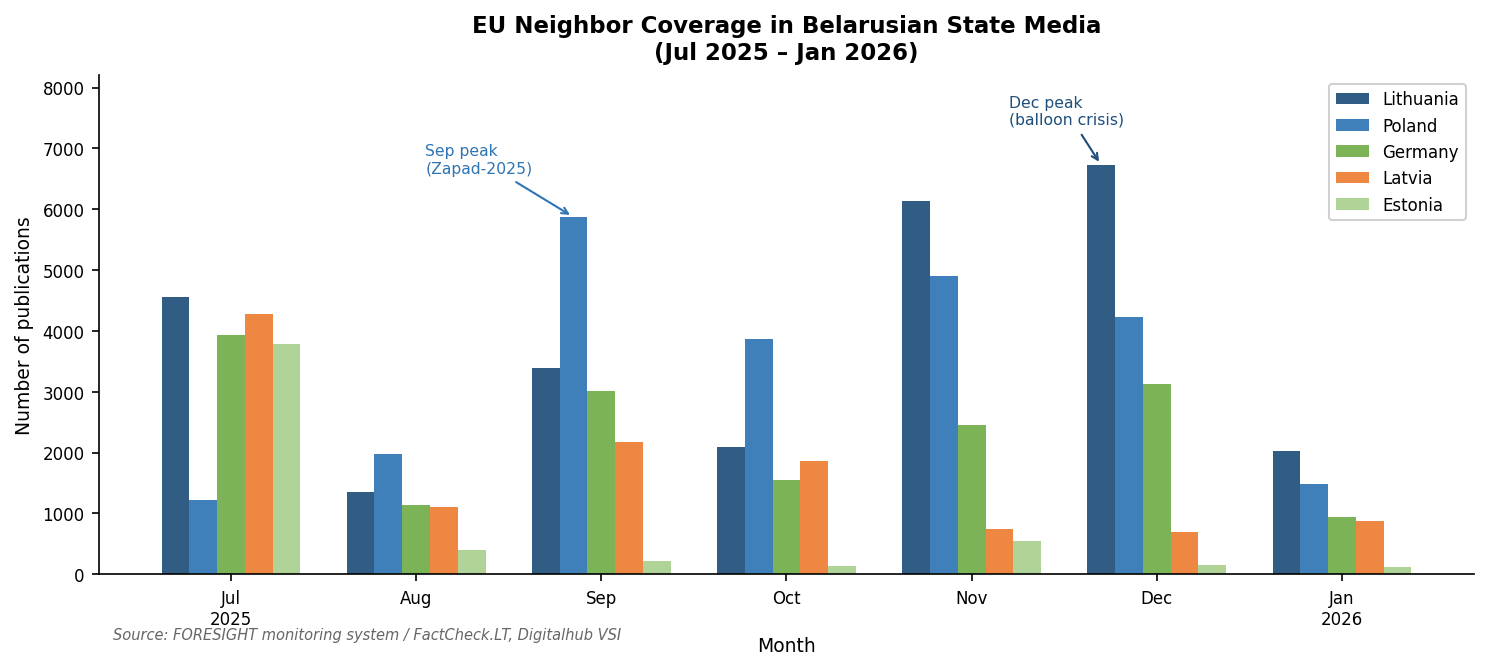
Figure 4. EU neighbor coverage in Belarusian state media, Jul 2025 – Jan 2026 (publications/month).
Source: FORESIGHT monitoring system / FactCheck.LT, Digitalhub VSI.
The peak in mentions of Poland in September (5,871) was linked to the Belarus – Russia West 2025 exercises: on September 9, 2025, Polish Prime Minister Donald Tusk announced the closure of the state border between Poland and Belarus starting September 11. Belarusian state media portray Poland not merely as a hostile neighbor but as a “historical claimant” to Belarusian territory and NATO military outpost. This narrative essentially reproduces the Russian image of Poland.
Germany, with its highest number of mentions in July (3,936 publications), is depicted through internal contradictions, such as the surge of ultranationalism and economic challenges. Latvia and Estonia are mainly referenced within narratives associated with “Russophobia.” The significant drop in publications about Estonia by January 2026 (112 compared to 3,781 in July) highlights the event-driven nature of the coverage: most of the July articles were related to the joint military exercises of Belarus and Russia (see Figure 4).
TikTok: a new battleground for information influence
By 2025, TikTok had fully established itself as a platform for political influence. Systematic monitoring shows consistent growth: in May, there were 245 active channels out of more than 300 monitored, with 10,946 videos and 417 million views; in July, 240 active channels out of over 400 (11,288 videos, 528 million views); in October, 249 active channels out of more than 500 (11,109 videos, with reach surpassing 600 million).6 These figures are comparable to the audiences of the country’s largest television channels.
The Belarusian TikTok landscape is structurally quite different from platforms like YouTube or Telegram: it lacks direct administrative control by the government. Instead, it is characterized by a complex network of channels that are officially independent but exhibit strong signs of coordination.
An analysis of 21 thematically related channels revealed a coordination index of 91.7 out of 100 (p < 10⁻⁸⁰), providing statistical evidence that the synchronization observed could not have occurred by chance.7 Among 83 instances of posts made within a one-minute window, 13 shared an interval of less than 10 seconds, ruling out manual coordination and indicating the use of automated systems (see Figure 5).
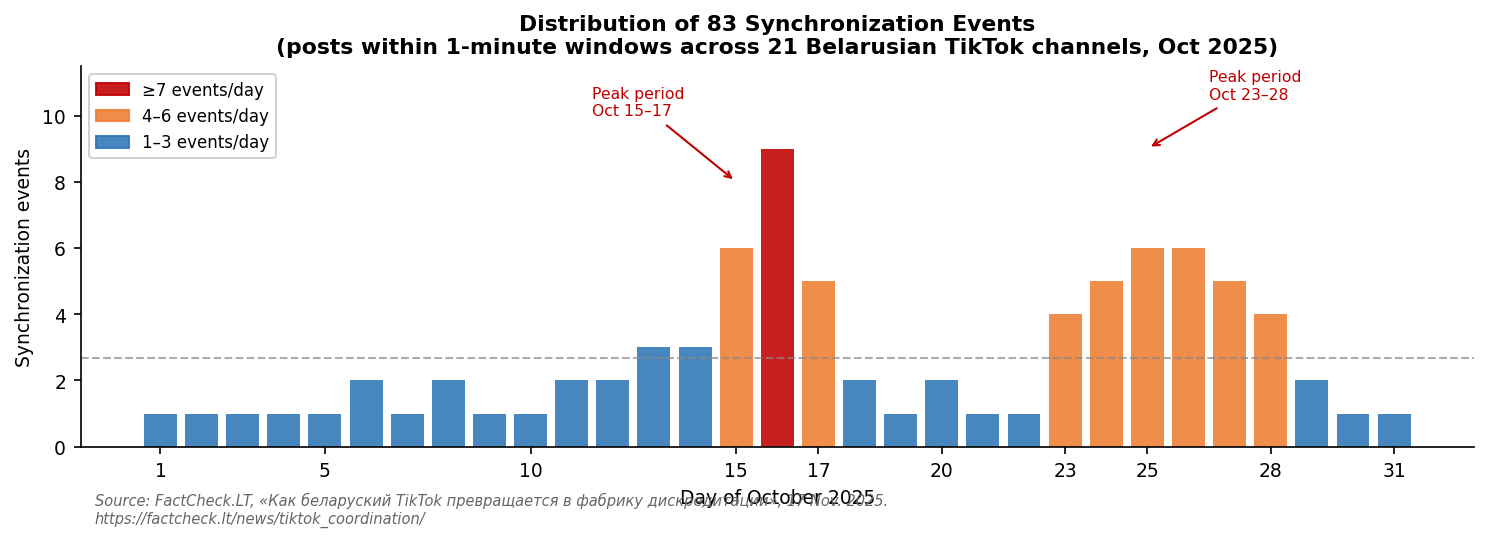
Figure 5. Distribution of 83 synchronization events (posts within 1-minute windows) across 21 Belarusian TikTok channels, Oct 2025
Source: FactCheck.LT, Nov. 2025, https://factcheck.lt/news/tiktok_coordination/.
Activity patterns throughout the day show distinct peaks at 9:00–11:00, 13:00–14:00, and 16:00–17:00, with a sharp decline after 19:00. This suggests the involvement of a professional team working on a typical office schedule (see Figure 6). Notably, there is a clear “working hours” pattern, with activity nearly nonexistent after 20:00.
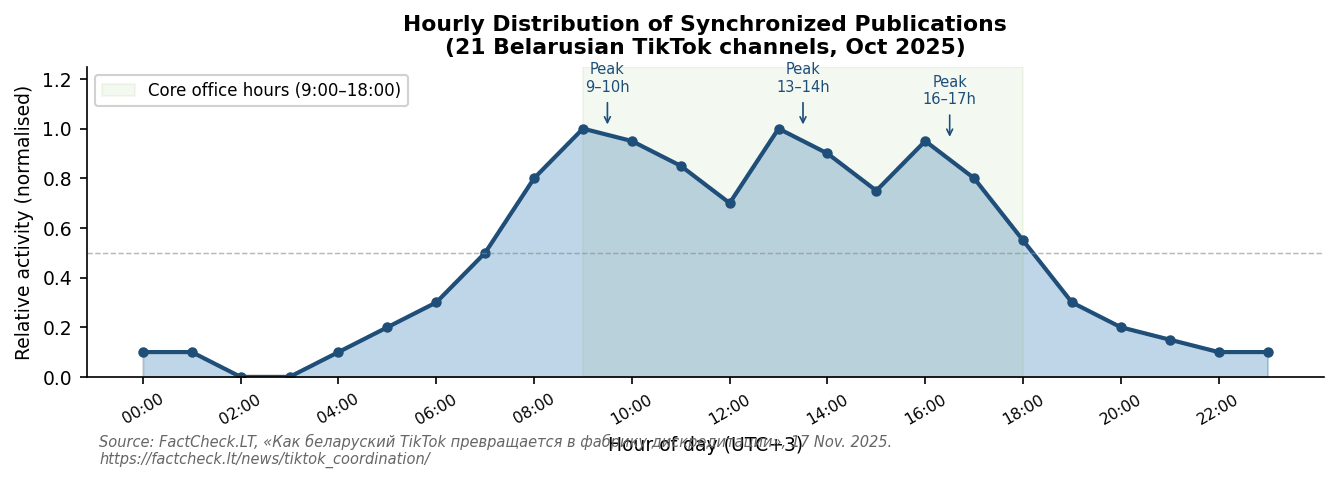
Figure 6. Hourly distribution of synchronized publications, 21 Belarusian TikTok channels, Oct 2025. Note the clear “office hours” pattern and near-zero activity after 20:00
Source: FactCheck.LT, Nov. 2025, https://factcheck.lt/news/tiktok_coordination/.
A key tactic in discrediting the opposition involved the hashtag #война (war) targeting opposition leaders: four main strategies were used — ridicule, contextual discrediting, narrative substitution, and comparative delegitimization. The hashtag #тихановский (Tsikhanouski) appeared in 87 posts, with 82.8 % concentrated within pro-government channels of the coordination core. The hashtag #оппозиция (opposition) was used in 10 posts, all within the same channels. This distribution is statistically inconsistent with organic use.
The most thoroughly documented case is the presidential elections in Poland (May-June 2025). The analysis of Belarusian state YouTube channels from April 21 to 27, 2025 revealed five coordinated narratives: absence of genuine choice, external control over the candidates, criminalization, potential election fraud, and widespread voter disillusionment.8 All materials appeared within a single week, with some featuring the same “experts” who cited each other — classic markers of influence operations.
Subordination or “spontaneous” harmony?
The combination of these processes raises a methodological question for the researcher: are we witnessing a coordinated or “spontaneous” harmony between Belarusian and Russian narratives? The 2025 data are compatible with both interpretations; however, several observations point in favor of the latter. The managed narrowing of the narrative repertoire (notably, the almost complete withdrawal of the “Anglo-Saxons” narrative, which nevertheless maintains its dominance in the state segment at around 98 %) suggests more an internal editorial logic reacting to the same geopolitical stimuli as the Russian side, rather than an external command.
The “NATO as aggressor” narrative, with only 64 % share of the state segment, is the only one in this regard reflecting its organic presence across the entire media landscape, which is characteristic of congruence (“accidental” synchronization) rather than mere targeted transmission. Furthermore, the involvement of independent media in the lexical trap of the “special military operation” in the fourth quarter occurs autonomously, through the negotiation context, without any dependence on the state segment.
Therefore, it is more accurate to speak not of the retransmission of Russian media operations, but of profound ideological congruence: Belarusian state media independently produce narratives that are compatible with those Russian content-wise, building on a shared institutional matrix of Soviet and post-Soviet origins. Regardless of which mechanism more precisely explains the reality, the observed outcome for the Belarusian media environment remains the same: the state media space operates as a domain where Russian and Belarusian propaganda agendas are virtually indistinguishable.
The independent sector faces simultaneous pressures on multiple fronts. Technologically: resource asymmetries on TikTok are structurally disadvantageous for content focused on deep engagement rather than broad reach. Audience-wise: access to the internal audience remains restricted. Financially: the crisis in donor funding, triggered by the freezing of American assistance in January 2025, remains unresolved. Legally: in 2025, there were 478 documented cases of pressure on media workers, 28 journalists remained imprisoned, and approximately 100 cases of extrajudicial persecution against émigré editorial offices were ongoing.
Collectively, these factors pose a systemic challenge not only to the Belarusian media environment but also to the stability of democratic discourse in the region as a whole.
Conclusion
In the near term, the degree of narrative congruence between Belarusian state media and the Russian agenda will be shaped by the course of negotiations over Ukraine: a sustainable ceasefire could enable partial editorial independence, while persisting conflict will reinforce the current model.
TikTok will become the primary battleground for influencing the internal, especially young, audience, and the asymmetry between coordinated pro-government networks and dispersed independent content is likely to intensify. Financial threats to independent media will remain as long as there is no structural response from European donors.